
I feel like this houseplant help question should win an award for 'Most Popular'. Not only because it gets asked so often, but because there are so many possible answers when you ask why your houseplant's leaves are turning yellow.
But actually, once you understand why it's happening, and know what clues to pay attention to, it's easier to work out the cause than it might seem, which means you can get on with fixing it before its too late.
BUT, until you do work it out (which we'll do together below), NEVER CUT OFF YELLOW LEAVES! (yep, all caps and bold). The reason why is coming up too...

Are yellow leaves a sign a plant's dying?
The short answer is maybe. That yellowing leaf may be damaged, dying or dead, but often it's NOT panic stations if your plant loses the occasional yellow leaf. It does NOT always mean the entire plant's going to drop dead any day now. But also yes, sometimes yellow leaves can be a warning of imminent death.
So as a general rule, never ignore this cry for help just in case yours is more dooms-day than a subtle hint something's wrong. It may also be nothing to worry about, but should never be ignored either way and is often an easy fix.
Why to NEVER cut off yellow leaves
Whatever the cause, the first thing NOT to do is cut off those yellow leaves. If you do chop off yellowing leaves, you could cutting off your plant's temporary life support! Until you find out why, and fix what's wrong, put down the snips.
Plus if you do yank the plug early, the plant won't have had time to create a scab. Pull that leaf off before it’s ready and you'll create an open wound that could let nasties in like bacterial and fungal infections :( Plants don’t clot and scab as speedily as we do.
Plus yellowing is often a sign your plant's on struggle street, so until you sort out why, your plant may be more prone to pests and diseases. Taking away its life support could add extra stress or shock that tips your plant over the edge.
Best to let Nature take its course on timing for when the leaf is ready to come off
That leaf is also NOT doing your plant any harm. It's a myth that plants 'waste energy' on dead or dying leaves. That's because plants don't heal themselves like we do. They just grow a new leaf!
Why an old leaf yellows when a new leaf is growing
Speaking of new leaves, if you're getting a yellowing leaf at the same time as your plant's putting out a new leaf, that often means you need to fertilise right away.
New growth increases your plant's demand for nutrients, especially nitrogen. Since nitrogen is a mobile nutrient, if your plant isn't able to get enough from the soil through its roots, it will take what it needs from an old leaf, sacrificing itself to support that new leaf.
Never cut off a yellowing leaf when a new leaf is growing, as it's currently supporting that new leaf, and DO give your plant a nutrient boost right away (more coming up about fertiliser).
The ONE exception when you SHOULD cut off a yellowing leaf
There is one exception. If you see signs of an infection (look for yellowing along with brown, mushy spots on leaves). Those you should trim off asap with sterile snips in the hope you get it before it spreads to the rest of your plant.
Clues to watch out for
Where on the plant those leaves are turning yellow, and the pattern of the yellowing, gives you important clues as to the cause (and the solution).
Here are the top 5 reasons why your plant's leaves are turning yellow, and how to get your plant well again before it's too late.
Reason #1. Watering Gone Wrong
If leaves are turning yellow and...
- it's started from older leaves first, nearest the soil,
- leaves are yellowing more evenly (not in patches or halos, not just between veins),
- it's happening to more than one leaf at once and/or,
- it's spreading one leaf at a time.
...that points to two possible causes > a water issue or a nutrient issue - a nitrogen deficiency specifically, as other nutrients tend to cause yellowing of newer leaves first. More about nutrient deficiencies up next.
Although over-watering usually gets blamed first for yellowing leaves, it can also be from under-watering. You'll probably know which one it is based on when you last watered, how wet the soil was and and how dry the plant was before you watered.
It's a common misconception that only over-watering causes root rot, but under-watering absolutely can cause it also, sometimes called 'dry rot'.
If you don't water often enough, or heavily enough, some roots miss out, dry out and die. Then when you do water again? Hello root rot :(
PRO TIP: Too much water does NOT cause root rot. But watering too often definitely can, especially when the substrate is still wet. When the plant does need watering, always water heavily so ALL the substrate gets saturated and no roots miss out. Yes, even for succulents and cacti.
Whether from under- or over-watering, root rot IS panic stations, so if you suspect under- or over-watering might be why, always rule out root rot first >
Reason #2. Soil Problems
If you're not over-watering or under-watering, yet your substrate either stays wet for ages, or dries out super fast, the substrate itself could be to blame.
If your soil holds more water than air, or stays wet too long, and that ISN'T what the plants likes, you can end up with root's drowning and dying from a lack of oxygen.
As roots rot and die, yellowing can be an early sign above ground that something's seriously wrong below the surface. How to check for and treat root rot >
The reverse might be to blame too. If your substrate dries out too fast or can't hold enough water, it can cause yellowing from a lack of both water and nutrients. Your pant simply can't get rnough of what it needs from the substrate.
Check if your plant is rootbound. Are there more roots than soil in the pot? Or is your substrate or potting mix a type that holds very little water even when wet? Maybe your substrates just dries out really quickly. Or your soil's become hydrophobic and the water just runs right through without soaking in.
Reason #3. Nutrient Deficiency
If you're sure it's NOT over- or under-watering, the substrate seems fine, and you've ruled out root rot (see that link above), then a nutrient deficiency could be the reason why.
The signs are similar, but how and where the leaf is yellowing gives you important clues to which nutrient it is. That's because some nutrients are mobile. Some are not.
If a nutrient is mobile it means the plant can move the nutrient around itself, usually taking it from older leaves to send to newer leaves, which is why yellowing in older leaves suggests a deficiency of a mobile nutrient.
Nitrogen deficiency = Older / lower leaves first, uniform yellowing
Nitrogen IS a mobile nutrient, so if it's a nitrogen deficiency, expect to see yellowing of older leaves first, nearer the roots.
One giveaway is also when you get yellowing of an old leaf happening at the same time a new leaf is growing, since nitrogen is needed in high amounts for foliage growth.
You'll also typically see uniform, more even yellowing, rather than yellowing in smaller patches or in round halos, and the yellowing won't be contained only within the leaf veins.
The yellowing also tends to move outwards, reaching younger / newer leaves last.
Potassium deficiency = Older / lower leaves, edges yellowing first
Potassium is also a highly mobile nutrient. It moves around freely through the sap, so if there's a deficiency, expect to see it show up in older, lower leaves nearer to the roots first.
A potassium deficiency also starts off with leaf edges turning yellow, but the inner leaf stays green. If not fixed by fertilising, those yellow leaf edges turn brown next.
Magnesium deficiency = Older / lower leaves first, mottled or marbled yellowing between veins
Another highly mobile nutrient, a magnesium deficiency starts as yellow mottled or marbled patches between the veins on older leaves first.
Yellowing usually moves from the leaf centre outwards, with edges turning yellow last.
Iron deficiency = Younger / newer leaves first, yellowing between veins
Iron is NOT a mobile nutrient, so expect to see an iron deficiency show up on younger, newer or upper growth first.
The yellowing starts between leaf veins while the veins stay green. The leaf between the veins may go pale green or yellow, and later white.
If it's a bad deficiency or has been going on for a while, yellowing can change to bleaching, with entire leaves turning white and dead, brown spots developing.
Sulphur deficiency = Younger / newer leaves first, yellowing between veins
Sulphur is another nutrient with limited mobility within the plant, so you'll see yellowing start on younger, newer growth and upper leaves first.
Yellowing tends to start on the tips and leaf edges first, moving inwards. On some plants a sulphur deficiency can turn leaf stems and stalks purple or reddish also.
Calcium deficiency = Younger / newer leaves first, yellow spots
Calcium is NOT a mobile nutrient, so you'll see yellowing start on newer, younger or upper leaves first. Usually appearing first as yellow or brown spots, with a yellow halo around them.
Reason #4: Soil pH
You might be seeing the signs of one or multiple nutrient deficiencies, yet you ARE feeding, AND when you check the label of your fertiliser, all the missing nutrients are right there!
That might be because the real issue is pH. When your soil pH becomes too acidic or too alkaline, it can cause some nutrients to be locked out from being absorbed, or turn some nutrients toxic.
Look up a pH nutrient chart, like this one below, and you can see where different pH levels begins to stop nutrient uptake...
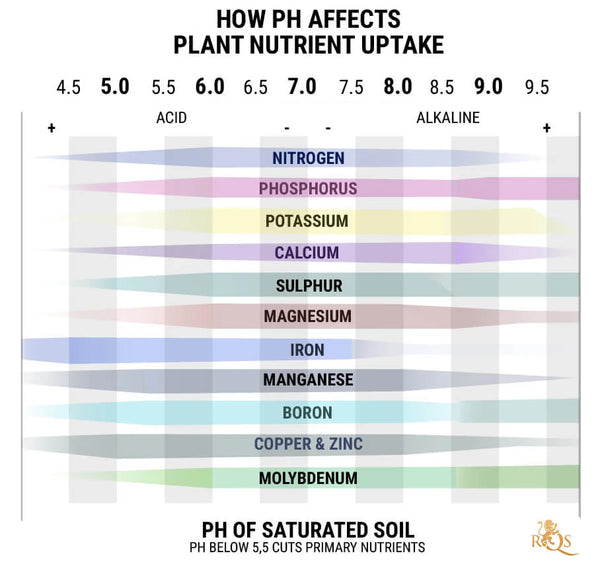
Although different plants have their sweet spots, for most houseplants a healthy soil pH zone is between 5.5 to 7. That's the range where most nutrients in the soil can be accessed by our plants. A small number of fertilisers these days are pH buffered, so just by feeding your plants you're also helping maintain a healthier soil pH.
Some ingredients in potting mix naturally buffer pH into an ideal range, but as the mix ages and breaks down, the pH can change. Consider if your plant is in old soil and repot if needed.
If your local water supply is hard water (look out for signs like limescale around taps and in your jug), or if you use bore water, your water could be too alkaline or have high levels of salts in it that can play havoc with your soil pH.
When the pH goes out of that healthy zone - even if all essential nutrients are in the fertiliser and soil - the roots can't access the nutrients, causing yellow leaves from (you guessed it), that same cause, a nutrient deficiency.
Avoid Bananas and Worms
There are a few reasons your soil pH can go bananas. And yes, one is actual bananas. As fun as it is (and the feel-good factor is great), DIY plant food can sometimes be bad news for our indoors plants.
Bananas tend to be pretty neutral (around 5), but banana peel can be way up around a pH of 9. I take a deep dive into the good and bad of banana skin tea for plants here >
Worm tea is another pH worry for indoor plants. The pH of 'worm tea' averages a whopping 8.5 depending on the source.
Maybe I did something wrong, but I ended up with fruit flies to add to my fungus gnats the first and last time I tried banana peel tea on my plants too. No thank you!
Keep in mind when going the DIY route if you want to give our indoor plants organic sources of nutrients, that indoor plants tend to grow in 'dead' soil, lacking all the beneficial bugs, bacteria, fungi and more found in healthy outdoor soil. Without 'living soil' our houseplants also lack the ability to break down organic goodies into nutrients the roots can uptake.
You might like to consider an inorganic fertiliser instead, where the nutrients are immediately available to indoor plants, no helping hand needed.
Signs Soil pH is Too Acidic or Alkaline
This one can be trickier to diagnose, because although the symptoms you'll see are still from a nutrient deficiency - or a toxic level of a nutrient - the cause can be due to the too-alkaline or too-acidic soil. Adding more fertiliser won't fix this one.
That's why a soil pH test or pH meter is the most reliable way to find out what's going on. You can also get one of those 3 in 1 meters that has a pH tester built-in, but they won't anywhere near as accurate.
Reason #5. Fertiliser Burn
If you show your plants a little too much love, you might have overdosed and have a case of fertiliser burn to deal with. However, I find the chances are pretty low of problems from one fertiliser overdose. Normally a good extra watering with plain water is all that's needed.
The reason fertiliser burn is lower down the list of common causes of yellowing leaves, is because it's a less common cause, but still something to consider if you've ruled out other reasons.
A variety of frustratingly vague symptoms can indicate over-fertilisation. What makes this one trickier still is that fertiliser burn doesn't often happen immediately, but instead happens over time as excess mineral salts build up in the soil slowly over time.
Common Signs of Fertiliser Burn
If you do see yellowing from fertiliser burn, it's more likely to show up as yellowing on leaf tips and edges first.
You might also see wilting even when the soil is wet. A white 'crust' of minerals might appear on the soil surface or around the drainage holes underneath.
Another sign is browning 'burned' leaf tips and edges. That's also a sign of irregular watering or underwatering. The reason that's on both lists is because both fertiliser burn and underwatering mean water and other nutrients aren't reaching the leaves.
Plants may try to get rid of excess minerals by sending it them to their leaf tips, so you can end up with an entire plant with brown leaf tips over time. Some plants are more prone to this than others, with Peace Lily, Spider Plants and Draceana all members of the brown leaf tip club.
It's not just excess minerals from fertiliser that can cause brown leaf tips, the minerals in your tap water can also, such as flouride and chlorine.
Weirdly, another sign of over fertilising is the same as not fertilising at all - and that's no or slow growth.
Another to add to the list is leaf drop (this one can be so dramatic when the whole plant does this in one go - eek).
All of those symptoms are because fertiliser burn damages the roots, causing nutrients to be unable to reach the leaves. Too much salt in the soil can also turn soil pH toxic and can 'steal water' from the roots, causing roots to die. Above the surface (you guessed it), that causes yellow leaves and eventually, plant death.
How to prevent fertiliser burn
Some fertilisers are lower risk than others. One option is a lower-salt fertiliser that avoids commonly fertiliser ingredients that measure high on the salt index. Growth Technology is one example, which has no chlorides or sodium.
No matter what fertiliser you use, top watering also helps reduce the risk of mineral salt build-up causing fertiliser burn, by flushing out excess salts every time you water.
Do keep in mind it takes a lot to over-fertilise unless you have a major stuff up, so remember to rule out the other causes of yellowing leaves first.
It's worth noting also that some plants are more salt-sensitive than others. Variegated plants for example are more prone to booth root rot and fertiliser burn because they grow more slowly than their all-green buddies.
That doesn't mean they should be starved. They still need fertiliser, just less (I use the Weakly Weekly Method for mine).
Bonus Reason #6. Insects and Infections
Not sure if 'bonus' is the right word here, since these reasons are actually the worst ones in my books.
If the yellowing is more mottled, appearing in patches, in spots or with stippling, it could be pest damage from the way some pests feed. These patterns are most often caused by what I call the 'vampire pests' that suck the sap out of your plant's leaves, such as mites, thrips and aphids.
Extrafloral nectaries are another possible cause of yellow or brown spots, especially if it's happening on a philodendron or hoya, more often seen underneath leaves, often with sticky or dry, salt-like deposits.
Leaf spot can be fungal or bacterial, and cause typically yellow or brown spots, sometimes with a yellow halo around the spots.
Another possibility of yellowing appearing as spots, blotches or patches, is chemical damage. Insecticides, leaf sprays, rubbing alcohol, hydrogen peroxide and more can all cause yellowing to appear in spots or patches where it landed on leaves.
One more possible cause if the yellowing is mottled, is a virus, like the mozaic virus.
And some plants just really dislike the cold, and produce mottled yellowing as a result of cold shock (Raphidophora Tetrasperma or the 'Mini Monstera' is a common one where cold shock causes a pattern that often gets mistaken for the mozaic virus).
The End!
Well done, you made it! Those are the top 5 most common causes of yellowing leaves (and a few bonus causes).
Look for the clues. Where's the yellowing happening. What pattern is it taking. And remember what it most often down to is a lack of nutrients, whether it's water or minerals.
And until you work out what's causing that for your plant, keep those yellowing leaves on! They are your plant's temporary life support right now.
ABOUT THE AUTHOR: Anna is the owner of plant store Love That Leaf which specialises in products and advice for indoor plants. She is also the resident indoor plants writer for NZ Gardener magazine. Her houseplant care articles appear in print in magazines in-stores NZ-wide, and online on Stuff, The Post, NineHoney and more.